Understanding Single Tenant and Multi Tenant architecture ✨
Discover the key differences, benefits, and trade-offs of these two architectures

Have you ever wondered about the difference between having a blog hosted in Ghost Instance and a blogging platform like Hashnode? 🤔
Have you ever wondered about the difference in living in a villa and an apartment? 🤔

The difference between the above, pretty much sums up about Single Tenant and Multi Tenant architecture that might be commonly stumbled upon in the Software ecosystem
When comparing the architecture of a villa and an apartment, think of it in terms of space, independence, and shared resources.
🏘️ Villa Architecture: A villa is like a single-tenant setup in software architecture. It offers complete independence in terms of space, design, and customization. You have your own private land, no shared walls, and complete control over modifications, similar to how a single-tenant system allows a user full control over their environment. Villas also provide more space, privacy, and autonomy but come with higher maintenance responsibilities.
🏢 Apartment Architecture: An apartment, on the other hand, is akin to multi-tenant architecture. While you have your own private living space (your unit), you share walls, common areas, infrastructure, and amenities with other tenants. It’s more cost-effective, easier to maintain, and designed to accommodate multiple residents in a shared environment, just like how multi-tenant systems are designed to serve multiple users on shared infrastructure efficiently.
Single-Tenant Architecture
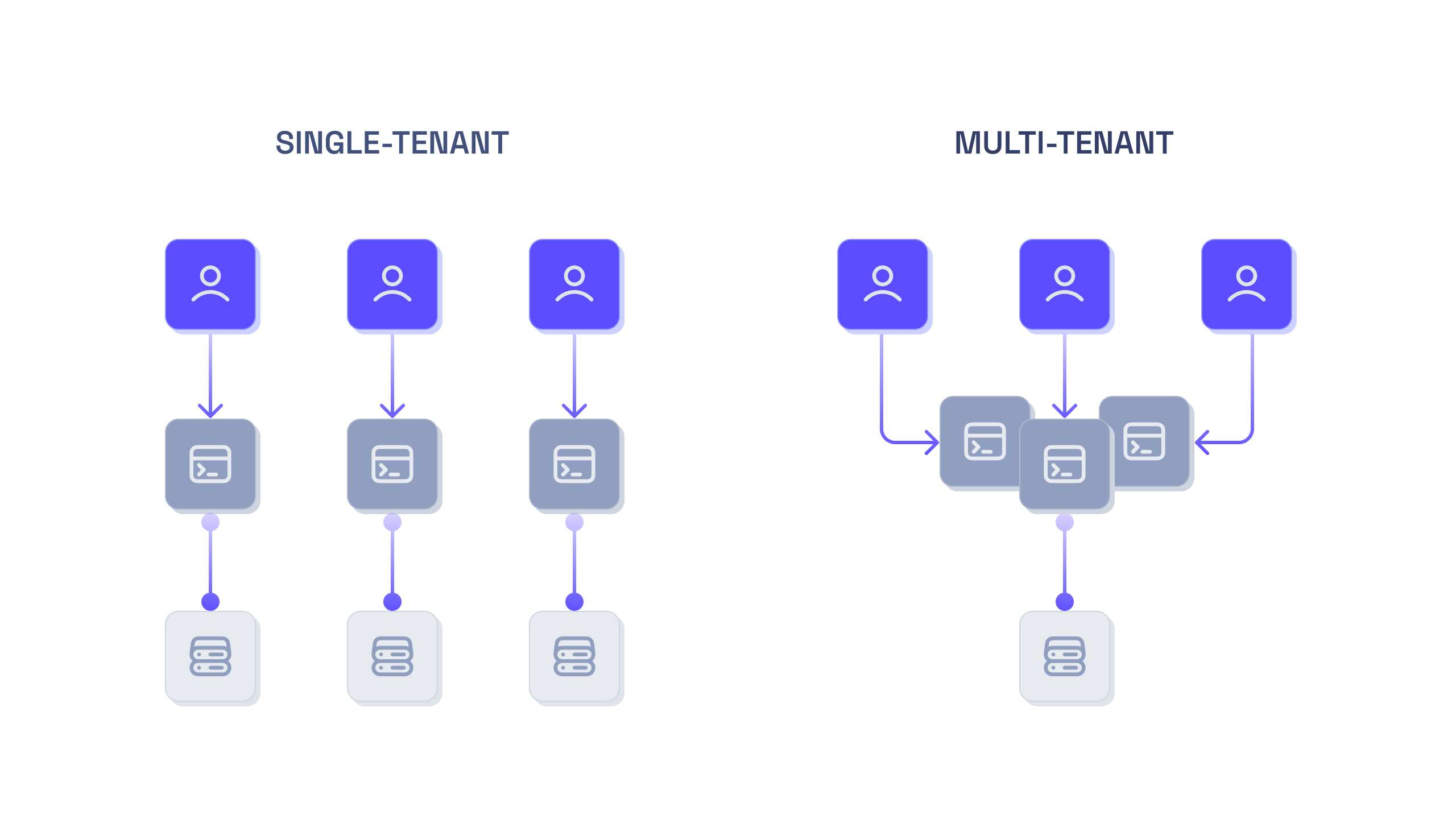
In a single-tenant architecture, each customer or tenant has their own dedicated software instance, which includes separate application instance and database environments. Technically, the software is replicated for each customer, ensuring full data isolation and customization at the cost of increased resource consumption.
For instance, a media company running a popular blog might self-host Ghost to ensure complete ownership of their content, customize the blog’s performance, and manage sensitive data directly. This setup is preferred if they have specific privacy requirements or need to make extensive customizations that wouldn’t be possible in a shared multi-tenant environment.

Key Technical Characteristics:
Dedicated Infrastructure: Each tenant has an isolated application and database stack, typically running on separate virtual machines or containers.
Data Isolation: Complete separation of tenant data with no shared storage or compute resources.
Customizability: High degree of flexibility in terms of software configurations, security rules, and application logic.
Security: Since each tenant operates in an isolated environment, security risks are minimized due to lack of shared resources.
Pros of Single-Tenant Architecture
Enhanced Security:
Full isolation ensures that each tenant's data is siloed from others. This prevents cross-tenant breaches that can occur in shared environments.
Attack vectors like shared database vulnerabilities are eliminated. Customers can configure their own security policies, firewalls, and encryption standards.
Full Customization:
Each instance can be highly tailored to the needs of the tenant, allowing custom features, unique workflows, and specific data structures.
Flexibility to modify backend configurations, database schemas, and even run custom plugins without affecting other customers.
Performance Stability:
No sharing of computational resources means consistent performance. High availability can be assured through isolated scaling and resource allocation.
Performance tuning for each tenant becomes easier. Tenants can deploy performance-enhancing services like caching, autoscaling, or load balancing without worrying about other tenants overloading the system.
Cons of Single-Tenant Architecture
Higher Costs:
The dedicated resources for each tenant make this architecture more expensive, as providers need to maintain separate instances for each customer.
Infrastructure costs can rise exponentially as each instance requires its own VM, storage, and network configurations. The provider also incurs higher operational overhead for managing, monitoring, and scaling individual instances.
Complex Maintenance and Upgrades:
Every tenant’s instance must be updated separately, which increases operational complexity, especially for bug fixes, security patches, and version upgrades.
Providers have to carefully manage version control and deployment pipelines for each instance. Automation tools like Ansible or Terraform become critical for managing infrastructure at scale.
Inefficient Resource Utilization:
Resources are allocated on a per-tenant basis, which often leads to underutilization.
CPU, memory, and storage resources might be wasted if a tenant doesn’t use their full capacity. This becomes inefficient compared to pooling resources across multiple tenants.
Multi-Tenant Architecture
In a multi-tenant architecture, multiple tenants share a single instance of the software and database. Although the resources are shared, each tenant’s data is segregated logically, usually at the database or application layer. I would consider SaaS applications are an ideal candidate for multi-tenant architecture.
A typical example is Shopify, where thousands of e-commerce stores share the same application instance, but each store has its own segregated data and custom configurations. Shopify scales efficiently by pooling resources across all tenants.

Key Technical Characteristics:
Shared Infrastructure: All tenants share a single instance of the software, often including the application server, database, and compute resources.
Data Segregation: Data is logically separated either at the database level (e.g., separate tables per tenant) or using a single database with tenant-specific tags (e.g., a
tenant_idfield in each record) with other techniques such as RLS (Row Level Security) is leveraged.Elastic Resource Utilization: Resources (CPU, memory, storage) are pooled and dynamically allocated based on tenant needs.
Scalability: It’s easier for the provider to scale the system because they only need to scale one instance rather than multiple isolated instances.
Pros of Multi-Tenant Architecture
Cost Efficiency:
By sharing infrastructure, the cost per tenant is significantly reduced. Providers can optimize hardware and software resources across a larger number of customers.
Tenants share common resources like load balancers, databases, and application servers, leading to reduced operational costs and more efficient scaling.
Simplified Maintenance:
Updates, bug fixes, and patches can be rolled out to all tenants at once, reducing the complexity of version management.
CI/CD pipelines are streamlined as the provider needs to manage only one instance. DevOps tools like Kubernetes can be used to automate rolling updates and deployments.
Scalability:
Multi-tenant architectures scale horizontally by adding more tenants to the same instance. Resources can be dynamically allocated based on load, allowing better handling of peak usage.
With autoscaling features in cloud platforms (e.g., AWS, Google Cloud), the provider can elastically scale the system to handle increased traffic without requiring separate infrastructure for each tenant.
Cons of Multi-Tenant Architecture
Limited Customization:
Since multiple tenants share the same application and database, there is less flexibility in customization. Changes made to the software affect all tenants.
Tenant-specific configurations are typically limited to front-end settings or user-level preferences, with minimal ability to alter core application logic or database schemas.
Security Risks:
Although tenants’ data is logically separated, a security vulnerability in the shared infrastructure could expose data across tenants.
A poorly configured shared database or a misconfigured security policy can lead to data leakage across tenants.
Performance Fluctuations:
Resource usage spikes from one tenant can affect the performance of other tenants sharing the same infrastructure.
Even with resource limits, a heavy-load tenant can degrade performance for others. Providers might need to consider performance tuning and load balancing to handle such cases.
Key differences
The decision between single-tenant and multi-tenant architecture depends on your business and technical requirements, particularly in the areas of cost, security, and scalability.
| Feature | Single-Tenant | Multi-Tenant |
| Customization | Customization completely in control | Limited Customization |
| Cost | Dedicated and Isolated infrastructure | Comman and shared resources |
| Security | Complete data isolation | Shared infrastructure risk |
| Scalability | Low - Vertical scaling per instance | High - Horizontal scaling across tenants |
| Resource Utilization | Isolated instances | Pooled resources, efficient use |
| Maintenance | Pretty complex as the number of instances increases | Simple - Centralized updates and management |
☺️ Summary
Single-tenant architecture provides maximum control, customization, and security, making it ideal for industries with strict compliance requirements (e.g., healthcare, banking). However, it comes at a higher cost and greater complexity in terms of maintenance and scaling.
Multi-tenant architecture, on the other hand, is highly scalable, cost-effective, and easier to maintain, making it the go-to choice for most SaaS providers serving a broad range of customers with standard needs.